
The church that welcomes jazz’s outer limits (JAZZWISE / 15 October 2026)
October 20, 2026
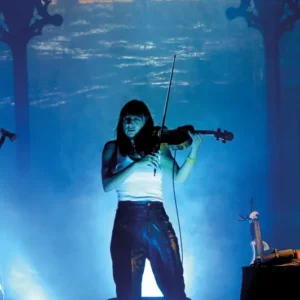
Anna Phoebe (photo: Tony Benjamin)
In the heart of Stroud, Gloucestershire a working church has become an unlikely home for avant garde jazz and outlier music, drawing performers and audiences from around the world. Tony Benjamin steps inside the sacred space of St Laurence Church to soak up some heavenly sounds
The 12-foot-high crucifix seems suspended in mid-air, silhouetted against the high vaults of a ceiling bathed in undulating purple light washes. Down on the stage below, picked out by subtle floor lights amid drifting misty smoke, guitarist Adrian Utley leads an improvising jazz quartet, his wailing electronic sound a foil to Larry Stabbins’ sinuous clarinet. The pair’s dialogue is grounded by Neil Charles’ remorseless bass and a growing thunder from Mark Sanders’ drumming. In front of them, shrouded in darkness, around 400 attentive people, some seated, others standing, are gripped by powerful music impeccably engineered and amplified. It is the opening night of Stroud’s annual Hidden Notes festival in St Laurence Church and, as always, it’s sold out.
Afterwards Utley is fulsome about this first experience of the venue: “Amazing, really beautiful. I definitely want to play here again.” His feelings are not unique. The Hidden Notes crew are frequently pestered by artists wanting repeat gigs and word has gone out around the global network of outlier music they aim to highlight. Festival co-curators Alex Hobbis and Adam Hinks acknowledge the uniqueness of the setting, as Adam says: “It’s amazing. The architecture, the scale of the space, the light, the sense of history, all of that becomes part of the festival. There’s something slightly surreal about seeing and hearing the kind of music we programme in a place like St Laurence. It gives the whole thing a character that we don’t think we could recreate in a conventional venue. To be honest, we can’t really imagine doing Hidden Notes anywhere else. We’ve been asked a number of times by established music venues around the UK if we’d consider holding Hidden Notes there but I think we’d lose something in the process. St Laurence isn’t just where the festival happens, it’s part of the festival. The building, the acoustics, the history, the slightly unconventional nature of the space all feed into how the weekend feels.”
St Laurence isn’t just where the festival happens, it’s part of the festival. The building, the acoustics, the history, the slightly unconventional nature of the space all feed into how the weekend feels
As well as Hidden Notes the church hosts its own Sacred Music Festival and is a major venue for the annual Jazz Stroud programme, somehow proving equally appropriate for Gregorian chant, contemporary classical music, avant garde electronics and jazz in all its shapes and sizes. What is remarkable is that it is not a deconsecrated building: the church still thrives actively as a centre for Christian worship. However for the last five years this cultural dimension has become part of St Laurence’s stated mission as church volunteer (and Sacred Music Festival producer) Katie Lloyd Nunn explains: “The pews were taken out in 2014 and shortly after that the Reverend Simon Howell arrived as Pioneer Minister. We had the first Sacred Music Festival all over the town and it was a big hit. That changed the image of the church, but it was the first Hidden Notes in 2019 that was the game changer. He’s a lover of world music and so it blew Simon away. Once the pandemic was over we decided to designate the church as Stroud Centre for Peace and the Arts. It’s quite a flag to fly. It means we are obliged to develop this side of our work.”
Stroud is a great place to launch such a project. The small Gloucestershire market town houses a considerable creative community of artists, writers and musicians as well as a thriving live music scene. The German amplification pioneers d&b audiotechnik have their UK HQ near Stroud in Nailsworth, and the local Goods Shed venue is a showcase for their state-of-the-art surround sound PA set up. Hinks is very grateful that the company also supports the events in St Laurence, providing excellent and powerful sound from a comparatively unobtrusive rig. And, while visitors to Hidden Notes and Jazz Stroud can come from as far as Japan and America, Stroud’s own culturally aware populace can be relied upon to support even the most outlandish performances.
Crucially, there is a strong sympathy between the church and the event organisers that creates an important human dimension to whatever happens there. Lloyd Nunn calls it “deep hospitality” based on reciprocated respect, and Hobbis agrees that “it feels much more like a collaboration than simply hiring a venue”. Performers regularly praise the supportive warmth they have experienced, often hanging around in the general throng long after their set has ended. In proactively welcoming diversity and acceptance of the unusual it seems that St Laurence Church’s Stroud Centre for Peace and the Arts, working with promoters like Hinks and Hobbis, has established a remarkable setting for unique musical experiences.