

St. Laurence Church: Stroud Centre for Peace and the Arts is very grateful to be receiving support from the National Lottery Heritage Fund in support of St Laurence Restored
A glimpse into the deep roots of St Laurence Church and its importance to the people of Stroud. Shaped by generations of faith, heritage, and community, the film reflects both the church’s history and the exciting potential for its future growth and cultural life.



Buildings Regeneration Programme
The St Laurence Regeneration Programme consists of projects, large and small, to restore and improve the buildings and churchyards of the St Laurence Site. Our Buildings Regeneration Group was formed in 2021 to oversee these projects and would welcome new members with relevant skills and experience.
The main focus is on the church building, which is Grade II* Listed and since 2024 has been on the national Heritage at Risk Register, which states:
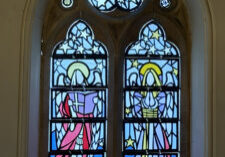
“The roofs now have rusted tile fixings [meaning that tiles are slipping off], the rainwater goods are rusting and failed, the stonework is eroded and the stained glass windows need urgent repair.”
To that we could add that some roof timbers have rotted, and parts of the north side are subsiding.
In October 2025 we were delighted to be able to announce the success of our bid to the National Lottery Heritage Fund for the first phase of a major project (called “St Laurence Restored: Protecting Stroud’s Historic Heart”) to save the church and make it no longer Heritage at Risk. Our press release announcing this news is here.
Vision for Buildings Regeneration
Our Vision for the regenerated St Laurence Site (as it will be when all envisaged projects are complete) was first set out in January 2024 and the latest version (October 2025) is as follows:
The social and cultural infrastructure of the St Laurence Site – including internal and external spaces, the organ and bells – is physically accessible, effectively used and appreciated by all.
The church and its surroundings are repaired and revitalised, their heritage reinterpreted, and they are a source of pride for Stroud people for the next century.
The church and the secluded semi-wild northern churchyard are open and welcoming as:
- Sacred spaces for reflection, sanctuary and solace;
- Resources to deepen understanding of the origins of Stroud and its historic buildings; and
- Resources to broaden appreciation of faith traditions, Christian and beyond.
People find it easy to access and join in creating activities that support inclusion, reduce isolation and counter polarisation.
The St Laurence Rooms facilities (Shambles Hall and The Upper Room) support the ongoing cultural and spiritual life of the combined site, particularly through revenue generation.
Work towards this vision really got started in 2014 with the removal of the pews from the church, enabling the flourishing of diverse activities that we have seen since then.


A survey of the condition of the church in 2022 caused it to be designated as Heritage at Risk. The scale of the work required to save the building led us to apply to the National Lottery Heritage Fund for funding of a major project called “St Laurence Restored: Protecting Stroud's Historic Heart” (or the “St Laurence Restored project” for short).
The summary of our funding bid reads:
St Laurence Restored will secure Stroud's significant central nineteenth century parish church, a culturally vibrant sacred space, enfolding an inter-spiritual hub that serves all of the people of Stroud.
By addressing critical repair and conservation needs, the project will remove the church from the Heritage at Risk register. The project will future-proof its fragile structure, restoring the roof, stonework, windows and rainwater goods, ensuring its longevity, especially in the face of climate change.
The project will broaden and deepen community engagement with the church. Creative events will bring the rich history of the church to life, and a range of organisations will work with us to create a lasting heritage interpretation project.
The project's legacy will be the continued flourishing of the church's already innovative and inclusive programming and increasingly sustainable operations; St Laurence will endure as a landmark and as a living, thriving part of Stroud's fabric and future.
In October 2025 we were delighted to be able to announce that our bid had been successful, and the National Lottery Heritage Fund are providing a grant of up to about £225,000 for the “Development Phase” of the project. Our press release announcing this news is here.
The Development Phase consists largely of detailed specialist investigations, designs for the physical works, estimates of materials and costs, gaining necessary permissions, putting the contract for the works out to tender, and fundraising. We are also working on developing the programme of community heritage engagement activities that will run alongside the physical works.
All that work will enable us to apply (in late 2026) for a “Delivery Phase” grant of about £1.9 million to implement the physical works and the community heritage engagement programme, starting sometime in 2027 if all goes well. The Delivery Phase grant will not cover all the costs, which is why we are fundraising in a big way in 2026. If you would like to contribute to this restoration click here or follow the QR code below.



Projects Already Completed
Since 2021, we have undertaken a number of projects, including:
- Removal of a significant asbestos hazard from a rarely-visited church basement
- Redecoration of the Shambles Hall (pictured)
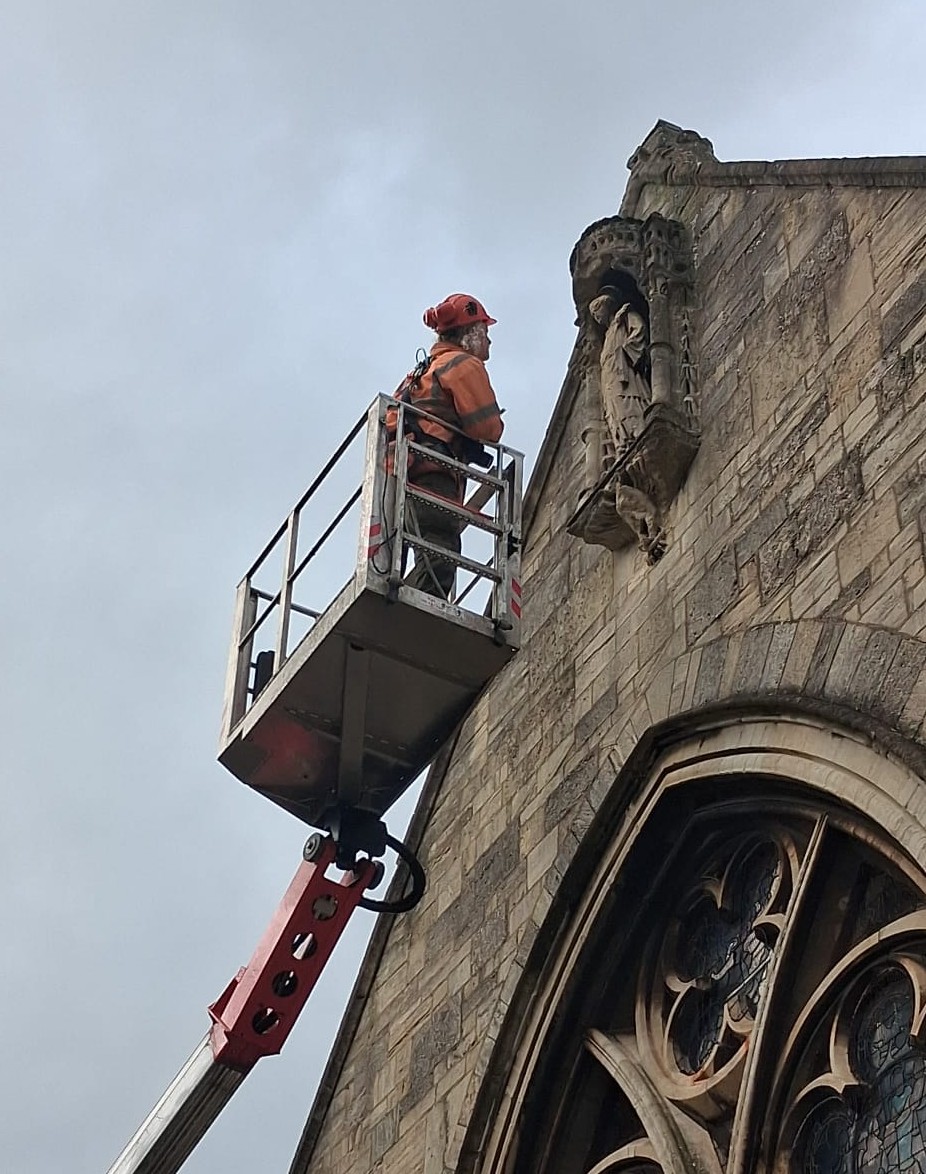
- Renovation of the north gable of the St Laurence Rooms building
- Improvements to the bells, funded and overseen by our dedicated ringing band – principally new rope guides in the ringing chamber
- Installation of six Herschel Halo overhead radiant heaters in the Nave of the church, part funded by a grant from Enovert Community Trust, as part of our church heating strategy

Further projects and opportunities to get involved
Now that we are confident that the church building exterior will be secured through the St Laurence Restored project, we are seeking to move forward with projects to improve the interior of the building as well. This will need further fundraising and more people with relevant skills and experience to volunteer to lead such projects.
As the St Laurence Restored project gets underway around the end of 2025, this is an exciting time to get involved with the St Laurence Regeneration Programme, with opportunities to influence how the buildings and churchyards will look and function in years to come.
Some of the key needs to be addressed are:
For the church:
- Further improvements to heating and energy efficiency taking account of the Church of England’s ‘Target 2030’ policy and our developing church heating strategy (below)
- Creating a contained space for smaller gatherings (e.g. enclosing the Lady Chapel - pictured)
- Making the main floor safer, more accessible and more durable
- Providing at least one accessible toilet within the building
- Providing some sort of catering facilities within the building
- Improved décor and lighting
- Improved sound facilities
- Improved welcome/information (front desk) facilities
- Improved presentation and interpretation of heritage features
- Improved usability of the organ
For the St Laurence Rooms (including the Shambles Hall)
- External repairs and refurbishment work
- Improved access from The Shambles
- Upgraded toilet facilities
- Upgraded kitchen facilities
- Improved energy efficiency and achieving net zero carbon by 2030
For the churchyards
- Improved presentation of historic heritage, as part of the St Laurence Restored project (e.g. the grave of the duellist Joseph Delmont)
- Improved accessibility to and within the churchyards and into the buildings (e.g. creating step-free access from Church Street)
If you are interested tin volunteering, in any capacity, to help or support this work please complete our volunteer form here

Developing church heating strategy
This is our top improvement priority for the church. It comes with a challenging goal: the Church of England’s target (set in 2020) to achieve net zero carbon across its parish, cathedral, diocesan and school estates by 2030.
The existing gas-fired central heating system for the church is old, inefficient, noisy and unreliable.
The central heating system for the St Laurence Rooms uses a modern, efficient gas boiler and gas usage is lower than for the church, and so replacing it is a lower priority.
Our strategy is to:
- work towards entirely electrically powered heating solutions;
- continue to purchase “green” electricity certified as 100% renewable; and
- continue to purchase “carbon neutral” gas (based on offsetting) for as long as we have to use gas.
Many other churches are taking on similar challenges, and we hope to share experience of difficulties we have faced as well as things that have worked well.
The Halo overhead radiant heaters (pictured) were installed in October 2024 to provide localised heating in part of the main body of the church for small and medium sized events and activities, and also as an experiment to see if this new technology could potentially be used to provide heating into the whole church without heating all the air.
Experience with the Halo heaters in the winter of 2024-25 showed that such technology on its own is not suitable for providing heating into the whole church. We are now trying to determine the best way of delivering heat into the whole church, particularly during events and activities that use most of the floor area, such as the Christmas Tree festival and numerous other well-attended activities in December.
We hope also to insulate the roof, which will reduce our energy use when heating the whole building and also make the Halo heaters more effective when background/starting air temperatures are particularly low.
